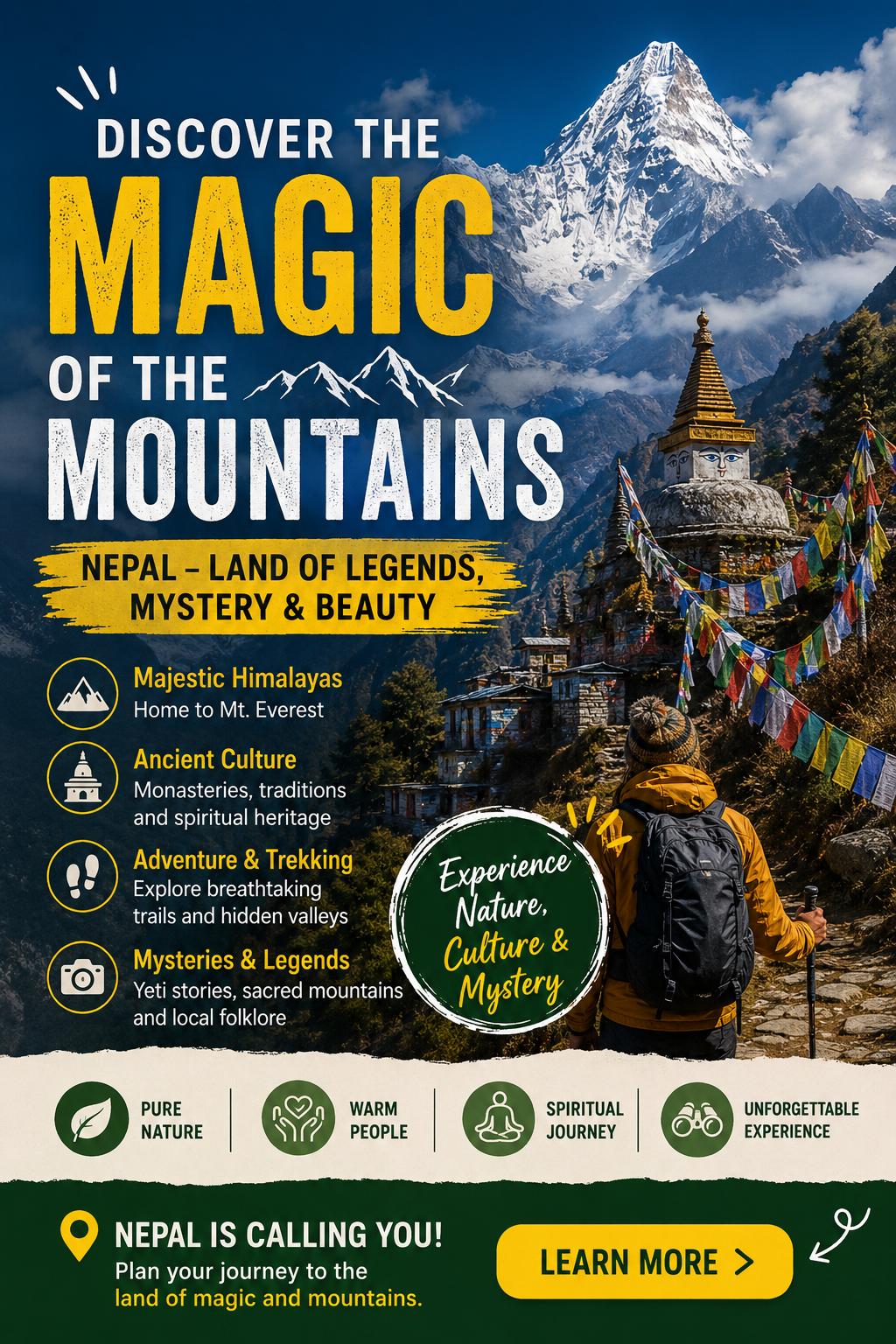
Mountains have fascinated people for thousands of years. Their enormous peaks, hidden valleys, ancient forests, glaciers, unusual wildlife, and dramatic landscapes have inspired stories about gods, spirits, mysterious creatures, sacred places, and unexplained events.
When people talk about the “magic of the mountains,” one country stands out particularly strongly: Nepal.
Nepal is home to Mount Everest and a large part of the Himalayas. Beyond its natural beauty, the country has a rich tradition of Himalayan mythology, spiritual practices, legends, and folklore. Nepal Tourism Board itself describes the country as a land of legends, myths, magic, and mystery, while highlighting traditional Himalayan beliefs and faith-healing practices.
1_Digital marketing
2_Education & Career
3_Finance & Persona
4_Health & Fitness
5_Study And Scholarship
6_Technology
7_Work From Home
It is important to clarify that “magic” in this article refers to folklore, mythology, spirituality, cultural traditions, and the sense of mystery associated with mountains. It does not claim that supernatural powers have been scientifically proven.
Why Is Nepal Famous for the Magic of the Mountains?
Nepal’s relationship with the mountains goes much deeper than tourism.
For generations, Himalayan communities have viewed mountains as sacred landscapes connected with deities, spirits, ancestors, and important cultural traditions. Mountains can therefore represent much more than rocks and snow: they can be symbols of protection, spirituality, nature, and community identity.
Research and cultural sources describe the Himalayan landscape as an important part of Nepali mythology and traditional beliefs. Stories from mountain communities include supernatural beings, sacred peaks, mountain spirits, and legendary creatures.
This combination of spectacular scenery and ancient storytelling has helped give Nepal its reputation as one of the world’s most mysterious mountain destinations.
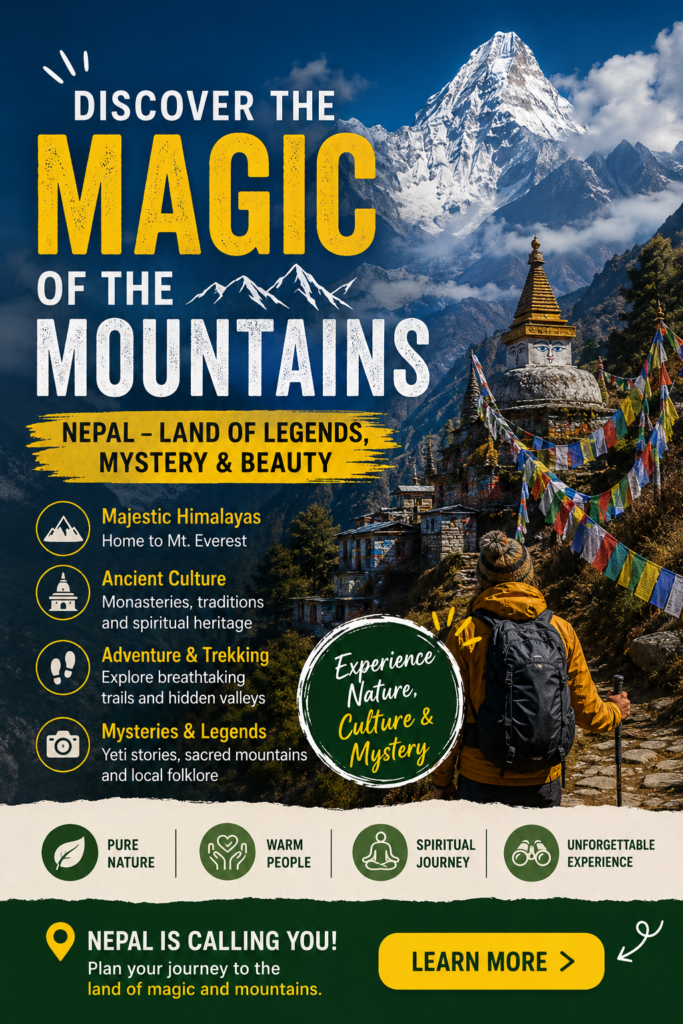
Mount Everest and the Mystery of the Himalayas
Mount Everest is the world’s highest mountain above sea level, but its importance to Nepal goes beyond its height.
The mountain is known in Nepal as Sagarmatha, while its Tibetan name is Chomolungma. Traditional interpretations connect the mountain with sacred and divine ideas.
For local communities, mountains can be living parts of a spiritual landscape rather than simply destinations for climbers.
The result is a fascinating contrast: modern mountaineering and tourism exist alongside traditions that treat particular mountains and landscapes with deep respect.
The Yeti: The World’s Most Famous Himalayan Mystery
Perhaps no mountain legend is more famous than the Yeti.
The Yeti is traditionally described as a mysterious human-like or ape-like creature associated with the high Himalayas. Stories about such beings have circulated among Himalayan communities for generations.
In Nepal’s Sherpa communities, Yeti stories are part of the folklore surrounding the mountains. Accounts of local traditions describe the creature as a legendary being connected with the wilderness and sacred mountain environment.
However, there is no conclusive scientific evidence that a Yeti exists as a previously unknown animal species. The Yeti should therefore be presented as a cultural legend and mystery rather than an established scientific fact.
That distinction is important for responsible travel and informational content.
Sacred Mountains and Mountain Spirits
Another important part of Nepal’s mountain mythology is the belief that natural places can have spiritual significance.
Traditional Himalayan beliefs may associate mountains, forests, rivers, and other natural features with spiritual beings or protective forces.
Nepal Tourism Board explains that animistic traditions in the country respect the earth and spirits believed to exist throughout the natural world. It also describes faith-healing traditions connected with these beliefs.
These traditions help explain why certain mountains and natural sites may be approached with special respect.
Shamans and Traditional Himalayan Practices
Nepal has a long history of diverse ritual and shamanic traditions.
Anthropological research has documented different forms of shamanism and spirit-medium practices among Himalayan communities. These traditions vary considerably between ethnic groups and regions, so it would be inaccurate to describe them as one single system.
In some communities, traditional practitioners have historically been regarded as people who can communicate with or work with spiritual forces.
From a cultural perspective, these practices are valuable because they demonstrate how mountain communities have developed ways of understanding illness, nature, morality, and unexplained experiences.
They should not, however, be presented as scientifically proven supernatural treatments.
Bhutan: Another Himalayan Country Famous for Mountain Mystery
Nepal is not the only Himalayan country associated with supernatural folklore.
Bhutan also has an extraordinary tradition of mountain myths and spiritual beliefs.
Bhutanese cultural traditions include stories about protective deities, nature spirits, demons, sacred mountains, and mysterious mountain creatures. Academic research has documented the important role of sacred landscapes and local spiritual beliefs in Bhutanese culture.
Bhutan’s tourism authority also presents the country’s mountains through a mixture of history, folklore, and traditional stories, including tales about the Yeti and other supernatural elements.
This makes Bhutan another fascinating destination for people interested in mountain mythology.
Nepal vs. Bhutan: Which Is More Famous for Mountain Magic?
Both countries have powerful mountain traditions, but Nepal has a particularly strong international association with Himalayan adventure and mystery.
Nepal
- Home to Mount Everest
- Famous worldwide for Himalayan trekking
- Strong traditions of mountain folklore
- Closely associated with Yeti stories
- Rich Hindu, Buddhist, and indigenous traditions
- Major destination for international mountain tourism
Bhutan
- Famous for sacred mountain landscapes
- Rich Buddhist and pre-Buddhist traditions
- Strong traditions involving spirits and deities
- Yeti-like creatures appear in folklore
- Many mountains have strong spiritual significance
If the question is “Which country is currently most famous internationally for the mysterious and magical character of its mountains?”, Nepal is a strong choice because the Himalayas, Everest, Sherpa culture, Yeti legends, trekking, and spiritual traditions have created a globally recognizable image.
This is a cultural assessment rather than an official worldwide ranking.
The Magic of Hidden Himalayan Valleys
The Himalayas contain far more than famous peaks.
Remote valleys can contain ancient monasteries, traditional villages, sacred trails, forests, glaciers, and places that have remained relatively isolated from modern development.
Nepal’s remote regions have inspired stories about sacred landscapes and hidden places for generations. Recent travel reporting on the Tsum Valley, for example, describes a remote Himalayan region with ancient monasteries, Buddhist cultural traditions, and a strong sense of spiritual heritage.
For travelers, the “magic” of these places often comes from the combination of silence, landscape, history, architecture, and living culture.
Why Mountains Inspire Stories About Magic
There are several reasons mountains have become associated with mystery throughout human history.
1. Remote Locations
High mountains can be difficult to reach. Historically, isolated locations encouraged stories about unknown creatures and mysterious events.
2. Extreme Weather
Fog, snowstorms, avalanches, unusual echoes, and rapidly changing weather can create experiences that seem mysterious.
3. Limited Visibility
At high elevations, clouds and darkness can dramatically change the appearance of the landscape.
4. Ancient Traditions
Mountain communities have preserved stories for generations. Some legends may be centuries old.
5. Sacred Landscapes
Many cultures consider mountains sacred because they are seen as places close to the heavens or as sources of rivers and life.
6. Human Imagination
When people encounter an enormous and unfamiliar landscape, stories naturally develop around it.
Is Mountain Magic Real?
This is one of the most interesting questions.
There is a major difference between cultural belief and scientific evidence.
A legend can be culturally meaningful without being scientifically verified. The Yeti is a good example. It remains an important part of Himalayan folklore, but its existence as a mysterious animal has not been established by reliable scientific evidence.
Similarly, spiritual traditions can be deeply meaningful to the people who practice them without requiring them to be presented as scientifically proven supernatural phenomena.
A responsible article should respect cultural beliefs while clearly separating tradition, legend, personal experience, and scientific evidence.
The Real Magic: Nepal’s Natural Beauty
Perhaps the greatest “magic” of Nepal does not require supernatural explanations.
The country contains extraordinary mountain scenery, including snow-covered Himalayan peaks, deep valleys, high-altitude lakes, glaciers, forests, rivers, monasteries, and traditional settlements.
For many visitors, standing beneath the Himalayas, walking through a mountain village, watching sunrise over a snowy peak, or visiting an ancient monastery can feel magical even without believing in supernatural forces.
That emotional experience is one reason Nepal remains such an attractive destination for adventure and cultural tourism.
The Role of Responsible Tourism
Visitors interested in Himalayan legends should remember that these stories belong to real communities and cultures.
Travelers should:
- Respect local religious sites.
- Follow local customs.
- Ask permission before photographing people or ceremonies.
- Avoid damaging natural or cultural sites.
- Avoid presenting legends as scientific facts.
- Support responsible local tourism.
- Follow trekking and environmental regulations.
- Leave natural areas clean.
Respectful tourism allows visitors to experience Himalayan culture without turning sacred traditions into simple entertainment.
Other Countries Famous for Mountain Legends
Although Nepal is arguably the strongest international example, mountain mythology can be found around the world.
Bhutan
Bhutan has extensive folklore concerning sacred landscapes, spirits, deities, and mysterious mountain beings.
Tibet
The Tibetan Plateau and Himalayan region have inspired centuries of Buddhist, local, and mountain traditions.
India
The Indian Himalayas contain numerous traditions involving sacred peaks, holy rivers, saints, temples, spirits, and legendary creatures.
Japan
Japanese mountain folklore includes stories about supernatural beings and sacred mountains, particularly within traditional religious and folk practices.
Switzerland
The Alps have inspired legends involving mountain spirits, mysterious creatures, and dramatic natural phenomena.
Scotland
The Scottish Highlands contain famous folklore involving mysterious creatures, haunted landscapes, and legendary lakes and mountains.
These examples show that the association between mountains and mystery is a worldwide cultural phenomenon.
Nepal’s Unique Position in Mountain Culture
Nepal’s uniqueness comes from the way several elements come together.
It has some of the world’s most recognizable mountains, ancient cultural traditions, famous trekking routes, diverse ethnic communities, Buddhist monasteries, Hindu sacred sites, and internationally famous Himalayan legends.
The country’s own tourism authority actively presents its Himalayan culture through themes of myths, legends, spirituality, and mystery.
This combination makes Nepal particularly powerful as a destination for people interested in the magic of the mountains.
Frequently Asked Questions
Which country is most famous for mountain magic?
There is no official global ranking for “mountain magic.” However, Nepal is one of the strongest and most internationally recognized examples because of the Himalayas, Mount Everest, Yeti folklore, sacred mountains, and diverse Himalayan traditions.
Is Nepal famous for magic?
Nepal is famous for myths, legends, spiritual traditions, and Himalayan mysteries. Nepal Tourism Board itself uses the concepts of magic and mystery when describing aspects of the country’s traditional Himalayan culture.
Does the Yeti really exist?
The Yeti is a famous Himalayan legend. There is currently no conclusive scientific evidence establishing it as an unknown animal species.
Is Bhutan also famous for mountain mysteries?
Yes. Bhutan has extensive folklore involving sacred mountains, spirits, deities, and mysterious mountain creatures.
What is the real magic of the Himalayas?
For many travelers, the real magic is the combination of enormous mountains, remote valleys, ancient cultures, wildlife, monasteries, traditional stories, and spectacular natural landscapes.
Conclusion
The magic of the mountains is a fascinating combination of nature, culture, history, mythology, and human imagination.
If one country has to be highlighted, Nepal is arguably the world’s most famous destination for Himalayan mountain mystery. Its connection with Mount Everest, the Yeti legend, sacred landscapes, traditional spiritual practices, and centuries of mountain folklore has created a cultural identity unlike almost anywhere else.
But the most important lesson is that the word “magic” does not necessarily mean supernatural power. Sometimes the magic is found in a sunrise over Everest, an ancient monastery hidden in a valley, a story passed from grandparents to children, or the feeling of standing beneath a mountain that has inspired generations.
The Himalayas remind us that some of the world’s most powerful stories are created where nature, culture, and imagination meet.
SEO Keywords
Primary keyword: magic of the mountains
Secondary keywords: magical mountains in the world, country famous for magic, mountain mysteries, Nepal mountain magic, Himalayan legends, Himalayan mystery, Yeti legend, Nepal folklore, magical places in Nepal, sacred mountains, mountain mythology, Nepal tourism, Himalayan culture, mysterious mountains in the world.