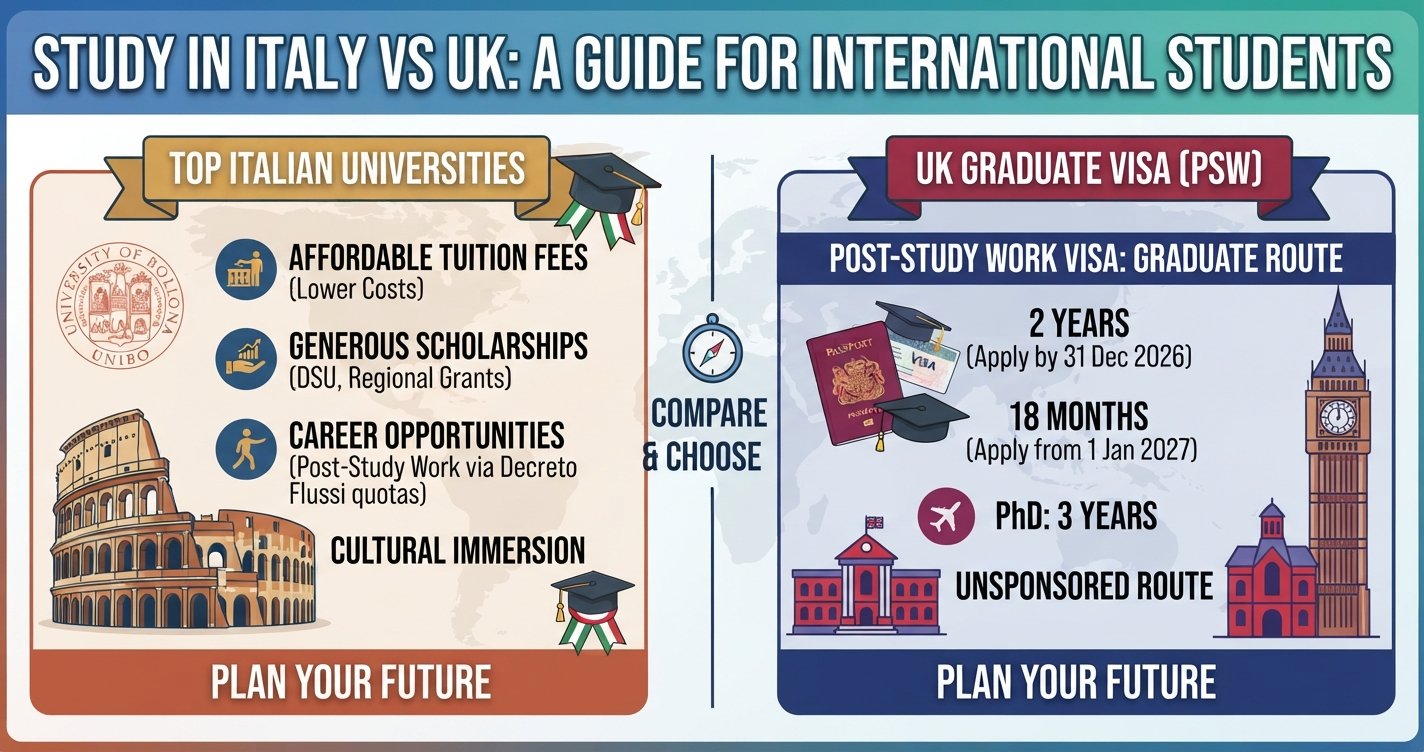
While the title of this guide mentions Top Universities in Italy, the text provided predominantly focuses on the United Kingdom’s Post-Study Work (PSW) Visa. To make this piece unique, comprehensive, and valuable for international students considering their options, this guide contrasts the academic and post-graduation pathways of Italy and the UK, highlighting top Italian universities, eligibility, scholarships, and career opportunities alongside key UK graduate visa updates.
Part 1: Top Universities in Italy, Eligibility & Scholarships
Italy has emerged as a top European destination for international students, offering world-class education, affordable tuition fees, and rich cultural experiences, all while teaching many programs entirely in English.
🏛️ Top Universities in Italy
- University of Bologna (UNIBO): The oldest university in continuous operation in the world, renowned for law, humanities, and sciences.
- Politecnico di Milano: Italy’s premier technical university, consistently ranked among the world’s best for engineering, architecture, and design.
- Sapienza University of Rome: One of Europe’s largest universities, excelling in classical studies, archaeology, physics, and engineering.
- Università degli Studi di Padova: Famous for its historical contributions to medicine, astronomy, and law.
- Politecnico di Torino: A leading institution for engineering and technical disciplines with strong industrial ties.
📝 Eligibility & Admission Requirements
- Undergraduate (Bachelor’s): Completion of 12 years of schooling and passing entrance exams (where applicable, such as IMAT for medicine or TOLC for engineering).
- Postgraduate (Master’s): A relevant bachelor’s degree from a recognized institution.
- Language Proficiency: Proof of English proficiency (IELTS/TOEFL) for English-taught programs, or Italian proficiency (B2 level) for Italian-taught courses.
💰 Scholarships in Italy
Italy is well-known for offering generous financial aid compared to the UK:
- Regional Scholarships (DSU / LazESU / EDISU): Provided by regional governments based on family income (ISEE). These often cover tuition fees entirely, provide free or subsidized housing, and include a cash stipend up to €7,000+ per year.
- Government Scholarships: The Italian Ministry of Foreign Affairs and International Cooperation (MAECI) offers grants for international students pursuing master’s and PhD programs.
- University-Specific Merit Awards: Institutions like Politecnico di Milano and the University of Bologna offer merit-based scholarships that waive tuition fees or provide living stipends.
Part 2: UK Post-Study Work (PSW) Visa Guidelines (2026 Updates)
For those considering the United Kingdom, understanding the post-study work framework is vital. Below are the latest rules governing the UK Graduate Route.
⏱️ Duration of Stay: 2 Years vs. 18 Months Rule
The UK Graduate Visa arrangement is undergoing scheduled changes:
- Applied on or before 31 December 2026: Bachelor’s and Master’s graduates can stay for 2 years.
- Applied on or after 1 January 2027: The duration will be reduced to 18 months.
- Doctoral / PhD Graduates: Remain eligible to stay up to 3 years.
Note: The duration is defined by the rules applicable on the exact date of application, not the course completion date.
📋 Key Highlights of the UK Graduate Visa
- Official Name: Graduate visa
- Application Location: Must apply from inside the UK before the current Student/Tier 4 visa expires.
- Sponsorship Required: No (unsponsored, highly flexible work rights).
- Application Fee: £937
- Immigration Health Surcharge (IHS): Generally £1,035 per year (£1,152.50 for 18 months, £2,070 for 2 years, £3,105 for 3 years).
⚖️ Quick Comparison: Italy vs. UK for International Students
| Feature | Studying in Italy | Studying in the UK |
| Tuition Fees | Generally low (Public universities range from €900 to €4,000/year, adjustable by income via ISEE). | High (£15,000 to £38,000+ per year for international students). |
| Scholarships | Widespread need-based regional grants (DSU/EDISU) covering living costs and tuition. | Mostly competitive merit-based scholarships (Chevening, GREAT, university-specific). |
| Post-Study Work | Graduates can convert a study visa into a work-search or employment visa under national immigration quotas (Decreto Flussi). | Un-sponsored Graduate Route (2 years or 18 months depending on application date). |
| Language of Instruction | Increasing number of English-taught degrees, though daily life requires basic Italian. | Fully English-speaking environment. |
Conclusion
Choosing between Italy and the UK depends on your financial planning, career goals, and lifestyle preferences. While Italy offers remarkably affordable education backed by extensive regional need-based scholarships and rich cultural exposure, the UK provides a streamlined, un-sponsored post-study work visa framework. Be sure to review official portals—such as GOV.UK for UK immigration updates or specific Italian university portals for admissions—before submitting your applications.